
Netherlands Cohorts Consortium (NCC)
Netherlands Cohorts Consortium (NCC):
a nationwide large scale infrastructure for population health sciences
NCC is a unique infrastructure of prospective cohort studies in the Netherlands, focusing on the aligned collection, harmonization, and pooling of extensive data to unravel multifactorial causes of chronic diseases and their complex interplay (Figure 1). The population-based and population-representative cohort studies in NCC provide advanced longitudinal clinical phenotyping and biomedical data. Through NCC, researchers will have access to this diversity of data concerning mental and physical health, sociodemographic, lifestyle, economic, and environmental factors.
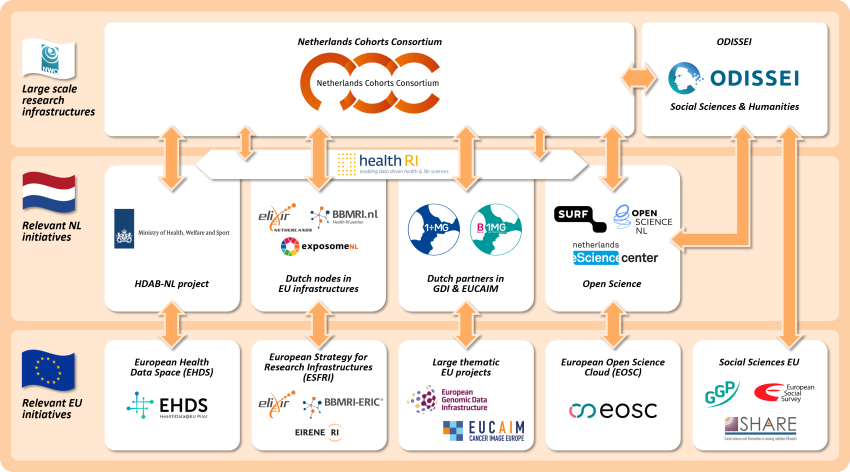
Researchers will also benefit from a technical infrastructure that enables advanced joint data analysis. Close collaboration with existing national and European infrastructures (e.g. BBMRI-ERIC, EIRENE RI, GECCO, ODISSEI), as well as extensive linkage with external data sources such as the Central Bureau of Statistics Netherlands (CBS), PALGA, the Dutch cancer registry (NKR) and other registries, will further strengthen the possibilities for excellent multidisciplinary research.

Participants
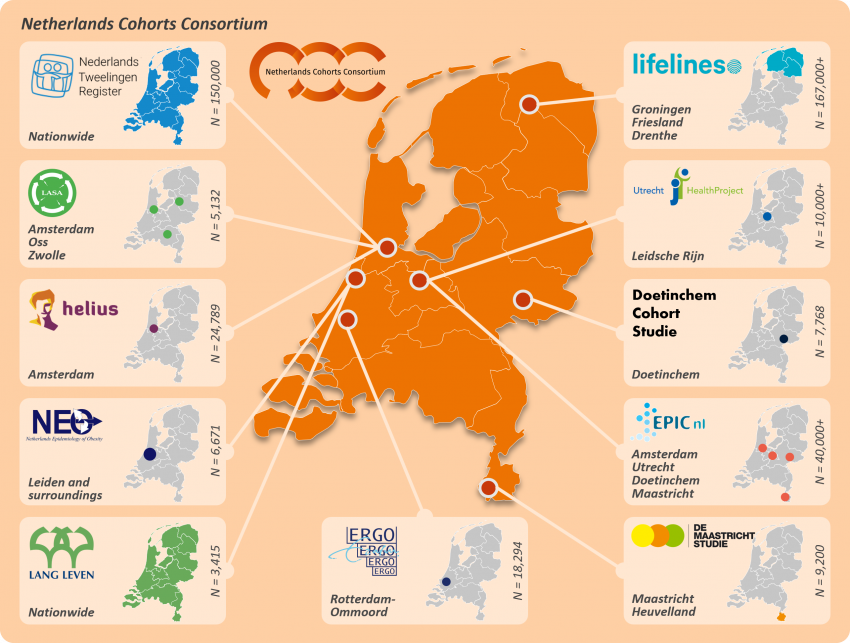
NCC currently consists of >440.000 participants from the Netherlands, originating from 11 population-representative cohort studies listed below (Figure 2). In the future, additional population-representative cohort studies will be able to join the consortium.
Data access
Within NCC, researchers will be able to obtain an overview of existing (meta)data from the NCC cohorts that may be used for scientific research, submit a request for use of NCC data from multiple or all affiliated cohorts, and gain access to NCC data via one NCC entry point. The following link contains an overview of the current NCC cohorts' data on diabetes, depression, sociodemographic and anthropometric characteristics, and lifestyle factors: https://software.memic.maastrichtuniversity.nl/ncc
Currently, all cohort studies have their own conditions and procedures for data access. Researchers can apply for data according to these individual procedures. In the near future, we will harmonize these procedures to provide researchers with a one-stop-shop opportunity to access data from all cohorts included in NCC.
NCC and existing infrastructures
The diverse and longitudinal active data collections of our cohort studies provide the needed basis for multiple existing infrastructures and initiatives, both on the national and international level (Figure 3). All individual cohort studies provide their study samples and outcome phenotypes to these infrastructures, thus forming the fundament of such enterprises. The NCC aims to guarantee the foundation these infrastructures are expected to build upon. Figure 3 gives an overview of the Dutch and European landscape of infrastructures to which NCC belongs and the partners NCC will collaborate with.
Ongoing and finished projects
Pilot projects
- The relationship between a history of obesity and COVID-19
- Sex-specific trends in obesity over time in the Netherlands
- Job-related health risks
- Toward reliable national figures on diabetes
Project Update NCC: Summer 2025 Edition
Written by NCC Project Coordinator Dr. Lana Fani
Collaborating for Better Data and a Healthier Society
NCC is in full swing. Behind the scenes, we are steadily building a sustainable and efficient collaboration between the largest population cohorts in the Netherlands. Thanks to this unique infrastructure, we can generate insights into public health, disease prevention, and healthcare policy like never before. In this update, we share several key milestones — from a formal collaboration agreement to the progress of promising pilot projects on obesity and diabetes.
Consortium Agreement Signed!
We are proud to announce that the NCC has officially signed the consortium agreement. This legal milestone lays a solid foundation for collaboration, clear arrangements regarding data access and intellectual property, and streamlined governance through our three levels: General Assembly, Strategic Board, and Management Team.
Pilot Project: What Cohort Research Teaches Us About Obesity in the Netherlands
Obesity is a growing public health issue with profound consequences for individuals and society. Within the NCC, I am working on a large-scale analysis of obesity prevalence in the Netherlands using data from various population cohorts. Thanks to variable harmonization, we gain: - Long-term insights into BMI trends across decades
- Comparisons between subgroups based on age, socioeconomic status, and region
The potential to conduct scenario analyses to predict the effectiveness of prevention strategies
In this project, we also successfully tested a centralized data analysis method: the combined data were collected at a single secure location — a major step toward efficient, scalable collaboration within the consortium. The analyses are now in full swing, and the first results are being prepared for publication. This lays the groundwork for evidence-based policy recommendations and a sustainable data infrastructure for future public health research.
Pilot Project: Toward Reliable National Figures on Diabetes
Effective diabetes management requires insight into prevalence and trends. In collaboration with the Diabetes Fund, we are working within the NCC on a project aimed at generating reliable, up-to-date figures on diabetes in the Netherlands.By analyzing data from over 400,000 participants from Dutch population cohorts, we:
- Map the occurrence, risk factors, and complications of diabetes
Calculate the societal and healthcare-related costs of this chronic condition
The results will serve as the foundation for well-informed public campaigns and targeted prevention strategies. Through this project, we ensure that findings are immediately applicable to refining prevention programs and improving healthcare allocation. Starting August 1, 2025, a dedicated researcher will join the project, working alongside Prof. Dr. Schram and myself to maximize societal impact.
Looking Ahead
With our signed consortium agreement, we have laid a strong foundation to scale up these pilots and future projects, supported by clear data access protocols and robust governance. The eventual scaling will also depend on the outcome of a major funding application, with a decision expected this fall. Stay tuned for more updates, new insights, publications, and concrete recommendations emerging from these projects!
Contact
Miranda T. Schram, Maastricht University Medical Center+, ncc@mumc.nl
NCC members and cohort details


Start 2003, 944 nonagenarian (90+) siblings from 421 families 2415 middle-aged offspring (1671) and their partners (744).


